
AI for small business: How to start?
AI is no longer an exclusive tool for large corporations with deep pockets. Small businesses can now leverage artificial intelligence to streamline operations and enhance...

Why AI isn't just for the big guys anymore
AI is no longer an exclusive tool for large corporations with deep pockets. Small businesses can now leverage artificial intelligence to streamline operations and enhance customer experiences. The evolution of technology has made AI accessible through affordable, user-friendly SaaS tools and chatbots. These innovations allow small businesses to automate repetitive tasks, saving both time and money.
With AI for customer service, small businesses can provide 24/7 support through chatbots that handle inquiries, process orders, and resolve common issues. This not only improves customer satisfaction but also allows staff to focus on more strategic tasks. Tools like DeepSeek AI and various AI summarizers simplify data processing and analysis, turning complex reports into actionable insights without needing a data scientist.
AI workflow automation tools integrate seamlessly into existing systems, enabling small businesses to optimize processes without a complete overhaul. Platforms like Salesforce AI and AI dashboards provide insights that were once only available to companies with dedicated research teams. This democratization of technology levels the playing field, allowing small businesses to compete with larger rivals. As AI continues to evolve, its role in helping small businesses become more efficient and competitive will only grow stronger.

Find your low-hanging fruit: The AI opportunity audit
Identifying the best opportunities for AI within your small business starts with understanding where your resources are being drained. Conducting an AI opportunity audit helps pinpoint repetitive, manual processes that are prime candidates for automation. By focusing on tasks that consume time but offer little value, you can streamline operations and enhance efficiency. Start with one high-impact area rather than getting overwhelmed by trying to tackle everything at once.
The 'Time vs. Value' Grid
Mapping tasks on a 'Time vs. Value' grid can clarify which processes to automate first. High Time/Low Value tasks are ideal candidates for automation. For instance, appointment scheduling often takes up considerable time but doesn't add much value, making it a perfect choice for an AI automation tool. On the other hand, Low Time/High Value tasks, such as strategic decision-making, should remain human-led to leverage personal insight and expertise.
Listening to customer friction points
Customer feedback is a valuable resource for identifying automation opportunities. Recurring issues like slow response times or booking difficulties highlight areas where AI can improve the customer experience. Implementing AI for customer service, such as chatbots or deepseek AI tools, can address common inquiries swiftly, enhancing satisfaction and freeing up human resources for more complex interactions.
Your first AI tools: A starter kit for smart automation
Starting with AI tools can transform small business operations by automating routine tasks and enhancing customer engagement. A thoughtfully selected starter kit can streamline processes across various domains, including customer service, marketing, and productivity. Here's a guide to some essential AI-powered tools that are accessible and budget-friendly.
Chatbots & Customer Service
AI for customer service is a game-changer, especially with tools like ManyChat and Drift. These platforms allow businesses to automate responses to frequently asked questions and qualify leads, freeing up human resources for more complex tasks. Setting up these chatbots involves defining simple conversation flows, where you map out potential customer queries and corresponding automated responses. This setup ensures that customer interactions remain smooth and efficient, enhancing overall satisfaction.
Marketing & Content Creation
AI tools like Jasper and Copy.ai offer capabilities for generating engaging copy for social posts, emails, and ads, making them invaluable for small businesses aiming to boost their online presence. Canva AI further aids by simplifying graphic design tasks. It's crucial to use these tools as assistants to enhance your unique brand voice, rather than relying on them entirely. This approach ensures that your marketing remains authentic and resonates with your target audience.
Operations & Productivity
For improved operations, AI-powered tools like Otter.ai provide automatic transcription and meeting notes, saving time and reducing manual errors. Calendly, equipped with AI features, optimizes scheduling by suggesting the best meeting times, thereby enhancing productivity. Additionally, basic AI-driven bookkeeping tools can categorize expenses, simplifying financial management. These tools contribute to an efficient AI workflow, allowing small businesses to focus on growth and strategic initiatives.
The 'Pilot Project' Playbook: Launch, learn, and scale
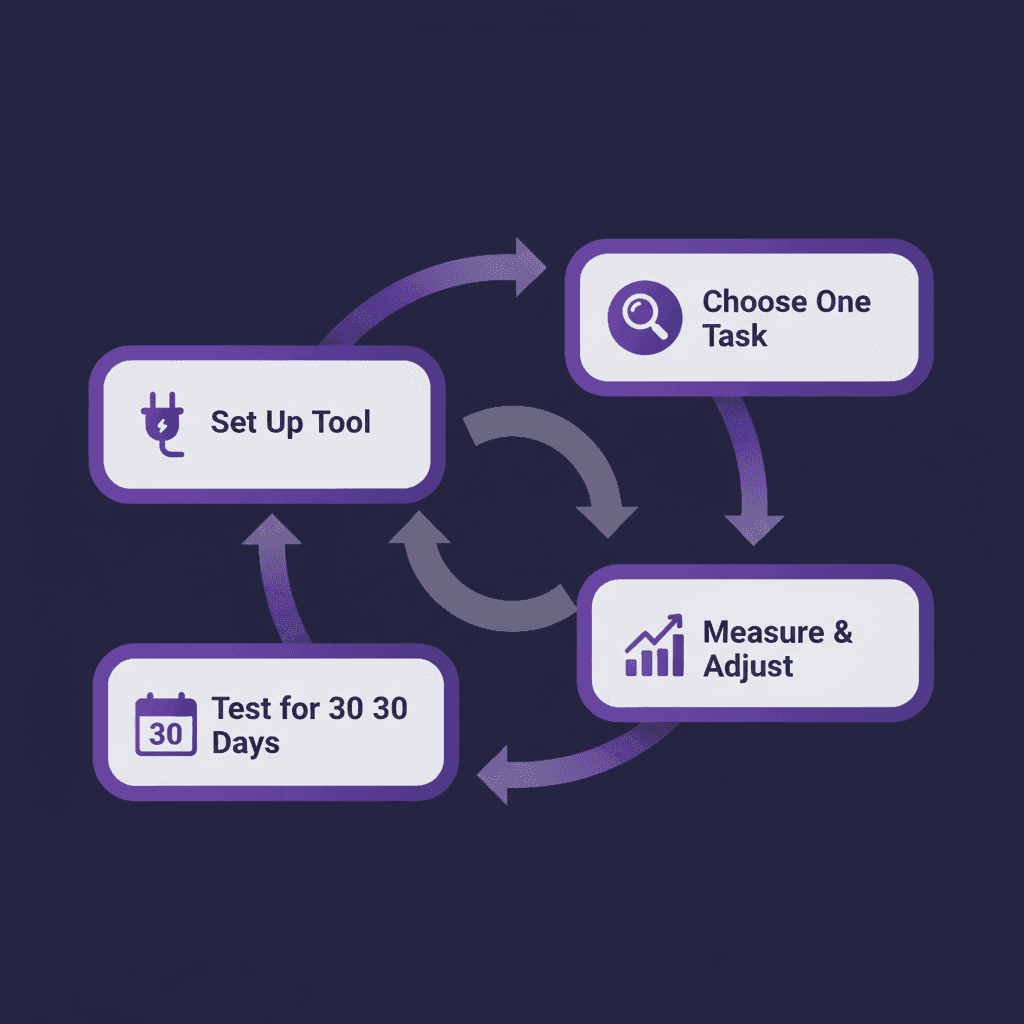
Launching a pilot project is a strategic way to integrate AI for small business operations. Start by defining a clear, narrow goal that aligns with your business needs. This could be as specific as using AI for customer service to reduce email response times to under two hours. Having a precise objective helps in selecting the right AI tool and measuring success effectively.
Once the goal is clear, select an appropriate AI tool. This might involve exploring options in an AI tools directory, comparing models like deepseek ai or a google ai model. The chosen tool should be easy to integrate with existing systems and require minimal setup. Salesforce AI or similar platforms often provide user-friendly interfaces for small business use.
Training your team is crucial for the success of the AI implementation. Ensure that team members understand how to use the tool efficiently. This might involve creating an ai workflow or using ai study tools to facilitate learning. Training sessions can be supported by ai dashboards or infographics ai for better comprehension.
Run the pilot project over a limited period, such as 30 days. During this time, monitor the performance and gather data using simple KPIs. An ai detection tool can help in assessing the effectiveness of the AI solution. Regular ai reports and an ai model comparison can provide insights into performance and areas for improvement.
Measure the results against the initial goal to determine the pilot's success. If the AI tool meets or exceeds expectations, consider scaling its use across other areas of the business. This methodical approach ensures that AI technologies are effectively integrated, driving efficiency and growth.
Avoiding shiny object syndrome: How to evaluate what actually works
Avoiding the trap of shiny object syndrome is crucial when integrating AI for small business operations. The allure of new AI tools can be tempting, but evaluating their true value is essential for strategic growth. Start by examining how well a tool integrates with your existing infrastructure. Check if it works seamlessly with your website, Google Calendar, or other software through APIs or plugins. This ensures smooth AI workflow without disrupting current operations.
Consider the total cost of ownership, which includes subscription fees and the time required to manage and learn the tool. Transparent pricing is vital, so be wary of hidden costs that could inflate your budget unexpectedly. Data privacy and security cannot be overlooked; ensure the AI tool has robust policies in place to protect sensitive information and clarify data ownership rights.
Quality customer support is another critical factor. Reliable support can save time and prevent frustration when implementing AI solutions. Evaluate the ease of use and the learning curve associated with the tool. Tools that offer free trials provide an excellent opportunity to test compatibility and assess their fit within your business before making a commitment. By adopting a framework for critical evaluation, businesses can focus on AI solutions that truly enhance their operations, rather than chasing every new trend without a strategic need.