
Automate smartly: when AI is helpful and when it goes wrong
Effective AI automation begins by addressing specific business problems, not by chasing the allure of advanced technology. The key question is not whether AI can...
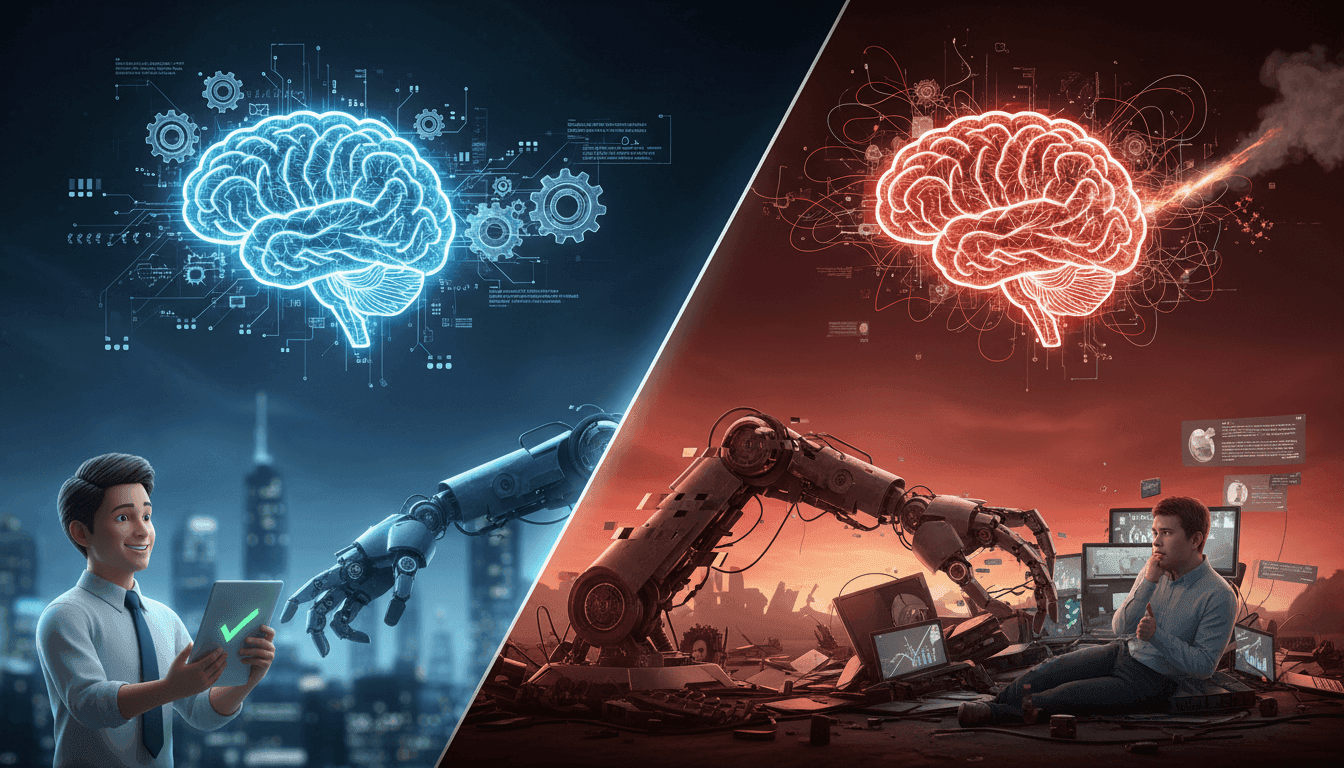
Start with the job, not the hype
Effective AI automation begins by addressing specific business problems, not by chasing the allure of advanced technology. The key question is not whether AI can be applied but what precise issue needs to be resolved. Identifying tasks that are repetitive, pattern-heavy, or language-rich can guide the decision-making process. These tasks often benefit from AI's capabilities, contrasting with tasks that are already efficiently managed by deterministic, rule-based systems. Successful automation starts with a well-defined workflow, a clearly measurable pain point, and a straightforward, specific outcome.
Tasks that are good AI candidates
AI excels in handling tasks involving messy text, classification, summarization, and fuzzy matching. These are areas where traditional rules-based approaches struggle due to variability and complexity. AI is also adept at support triage, where it can rapidly assess and categorize issues. Content drafting and scenarios with multiple valid outputs also benefit from AI, as it can explore a range of possibilities and generate creative solutions efficiently.
Tasks that should stay simple
For tasks that are straightforward and repetitive, if-logic, lookup tables, regular expressions, and standard algorithms often outperform AI in terms of speed, cost, and reliability. These methods are optimal when the problem is deterministic and the outcome is fixed. Simple algorithms shine in environments where precision and predictability are paramount, avoiding the overhead and complexity that AI models might introduce unnecessarily.
Where AI actually earns its keep
AI excels in scenarios where the input data is unstructured, where creating rules is complex, or where the sheer volume makes manual processing costly. In these contexts, AI acts as a force multiplier rather than a magical replacement for engineering solutions. It shines in reducing the time humans spend on ambiguous tasks, allowing them to focus on more strategic work.
One practical benefit of AI is its ability to process unstructured data, such as text, images, or audio, which traditional algorithms struggle to interpret without predefined rules. AI models can learn patterns and make sense of such data, providing valuable insights that would otherwise remain hidden.
When rules are difficult to define due to complexity or variability, AI can offer a flexible alternative. It can adapt to new data inputs without needing exhaustive rule sets, making it ideal for environments where conditions frequently change.
Finally, in scenarios with high data volume, AI can process information at a scale unattainable for human teams, reducing overhead and operational costs. By automating these labor-intensive tasks, AI allows businesses to allocate resources more efficiently, emphasizing its role as a complement to human effort rather than a stand-in for precise business logic.

When AI goes wrong and starts adding fluff
AI solutions can sometimes overcomplicate tasks that have straightforward, reliable solutions. This leads to unnecessary complexity, increased latency, and unforeseen maintenance costs. When AI is attached to simple problems, it can create more issues than it solves, such as unpredictable outputs and dependencies that weren't initially evident. This section explores the pitfalls of AI overengineering and how it can lead to inefficiencies rather than innovations.
The overhead trap
Integrating AI into a process often brings hidden overheads that simple algorithms avoid. These include the costs of designing prompts, making frequent model calls, establishing evaluation metrics, and setting up guardrails. Continuous monitoring and periodic retraining add further layers of complexity and expense. Compared to a plain algorithm that performs a specific task efficiently, AI can introduce unnecessary latency and vendor lock-in, making maintenance a costly endeavor.
The reliability trap
AI's non-deterministic nature is ill-suited for tasks requiring precision and compliance. When outputs vary, it becomes challenging to ensure consistency, which is crucial in fields like finance, healthcare, and legal compliance. Simple algorithms provide deterministic results, ensuring repeatability and reliability. When AI is applied to these contexts, it may lead to more debugging and confusion, undermining the very efficiency it was supposed to enhance.
A decision framework for choosing AI versus simple logic
Deciding between AI and simple logic requires a structured approach to ensure effectiveness and efficiency. By evaluating task ambiguity, tolerance for error, and the need for explainability, businesses can make informed choices. Consider the scale, latency, cost, and frequency of rule changes as crucial factors. AI excels when problems are fuzzy and potential gains are substantial, while simple algorithms and if-logic are ideal when rules are clear, outputs need precision, and edge cases are predictable.

Ask these questions before you build
Before diving into development, assess whether the rules can be clearly defined. If the task has a well-understood process and the outcome is objective, simple logic may suffice. Evaluate if the result is subjective or if it requires human-like judgment, which may favor AI. Consider the consequences of errors—how critical is it if the model makes a mistake? Additionally, determine if the task volume justifies the added complexity and overhead associated with AI implementation.
A simple scoring model
Implementing a scoring model can streamline the decision-making process. Assign weights to factors such as ambiguity, business impact, risk, cost, and maintainability. Rate each factor on a scale—higher scores for ambiguity and business impact may lean towards AI, while lower scores for risk and cost might suggest simple logic. This approach helps visualize the trade-offs and supports a more balanced decision whether to use AI, rules, or a hybrid solution.
Use a hybrid approach when the job calls for it
In many practical AI use cases, leveraging a hybrid automation system that combines AI with deterministic logic can lead to more robust and effective solutions. While AI excels in handling complex tasks like messy data intake, categorization, and language interpretation, rules-based logic ensures that the system adheres to validation, compliance, thresholds, and business constraints. This approach balances the potential pitfalls of relying solely on AI or sticking strictly to rigid rules, providing a more flexible and reliable automation decision framework.
AI for interpretation, rules for control
Architectures that successfully integrate AI and deterministic logic often utilize AI to extract meaning from unstructured data. For instance, AI models can be used to interpret natural language inputs or categorize complex data sets. Once this interpretation is complete, simple algorithms or 'if logic' take over to make final decisions based on predefined rules. This separation of roles allows AI to manage the complexities of data interpretation while the rules ensure that decisions align with business objectives and constraints, reducing AI overhead and complexity.
Fallbacks and guardrails
Every AI-driven workflow should incorporate fallbacks and guardrails to manage uncertainties effectively. Fallback paths ensure there is a safe mechanism to handle cases where AI's confidence falls below a certain threshold. These paths can involve human intervention or alternative decision-making processes to address uncertain scenarios. Guardrails, such as confidence thresholds, prevent AI from making high-stakes decisions without sufficient certainty, thereby minimizing risks and ensuring compliance with business rules. This layered approach ensures that AI enhances, rather than undermines, the reliability of automated systems.
How to keep AI from becoming a science project
To successfully integrate AI without turning it into an unwieldy science project, it's crucial to adopt a strategic operating framework. Begin with small, manageable projects that allow you to measure outcomes effectively. Establish clear baselines and compare AI results against them to ensure that the technology is genuinely adding value. AI should be treated like any other tool—its worth must be proven, not assumed. Evaluation and monitoring are critical components in this process. Regularly assess AI systems to ensure they are meeting performance expectations, and incorporate human reviews when necessary to maintain quality and relevance. It's equally important to periodically eliminate complexity that isn't delivering tangible benefits. AI overhead should be justified, and unnecessary complexities should be stripped away to maintain operational efficiency. Ultimately, the real advantage lies not in the sheer use of AI but in selecting the appropriate level of automation for each task. By applying a balanced AI automation decision framework, one can effectively navigate the choice between using AI versus traditional logic or simple algorithms, ensuring that AI serves as a practical tool rather than a burdensome experiment.